My mom and I had been searching for a wedding dress since I got back from Israel that both fit my style and my budget. We had only found two options, but they weren't great. One still required sleeves to be added, and the other was so large that tailors we have called told us not to get it. So, we kept looking.
I didn't know how difficult it would be to find a dress that was modest and fairly simple that also fits in my budget. I guess if I wanted to spend $1000 on a dress, I would have more options, but actually I have found that the more expensive the dress, the gaudier it is. I was something elegant and timeless, nothing poofy, not a lot of fabric, and I don't care for a train. We wanted to get something off the rack, both for budget reasons and because Emet and I will be leaving Atlanta soon and it would be better to have something before leaving for LA.
We have looked at bridal gowns, bridesmaids dresses, prom dresses, and even quincinera dresses. Not much luck unless we wanted to order from China, and we weren't sure how reliable those are, either.
Finally, we decided we will stop in to Bridals by Lori (yes, the one from Say Yes to the Dress) because it is around the corner from my house and it had a dress that I liked online. I figured we would see the dress that I liked online and if it worked, then maybe we would find a reputable place to order it online. Instead, we found the dress, I said Yes to the Dress, and I walked out with my dress purchased from Bridals by Lori. They have been fabulous so far - we wanted to add something to the order, and it was no problem, and the salesperson called to make sure the color of the ribbon is what I wanted. I'm happy!
Finding a modest wedding dress is no easy feat, especially if you are on a budget. I've realized the wedding dress shopping is ridiculous, wedding dresses tend to be outrageous (and often ugly), and the industry can charge you a lot of money just because it says "Bridal."
When looking for a modest wedding dress, here are my suggestions:
1. Look online for LDS wedding dresses. The Mormons have similar modesty rules as Orthodox Jews, and they have a lot more online stores, specifically - LatterDayBride, A Dressy Occasion, LDS Bridal Gowns, Totally Modest, and AltaModa Bridal. They have a lot of different styles and budget options. I also looked at Watters, Allure Modest, and other brands that I found had sleeves.
2. Consider bridesmaids or other special occasion dresses. I found that there were more options for sleeves on bridesmaids and special occasion or formal dresses. Plus, they are less expensive than wedding gowns.
3. You can look at bridal stores, but don't expect to find anything. I looked at David's Bridal and at least another 4 or 5 other bridal stores in the Atlanta area. None had anything in my size, my budget, or my style. I tried on a LOT of dresses and quickly became discouraged. But we kept looking, and I tried on everything that was even remotely close or far from what I wanted. If it was my size, I tried it, even the ones I thought were very ugly.
4. Look into a custom made dress. If you can't find anything, see how much it would be to have a custom made dress. If you know someone who sews, you're in luck! Ask them to do it as your wedding present or offer to pay them back in-kind if you can't afford it all. I found that having a custom gown was just as expensive as buying a new gown, but I didn't know anyone who sewed.
5. Be optimistic. I didn't think that I was going to find anything. For weeks, I scoured the internet to find the style I liked, and then I spent time feeling discouraged that there wouldn't be anything out there. Despite that, I found exactly what I wanted - not at a place I expected, though. You never know where you might find it.
Tuesday, March 25, 2014

Tuesday, February 4, 2014
Shabbat: New Experiences and Emotions
Since I've been keeping Shabbat, I have had some that are absolutely fabulous and some that aren't as much. It depends on whom I'm with, mainly. This past Shabbat was so amazing; I can only attempt to explain it.
On Friday night, Emet and I went to a Reform shul. I haven't gone to a reform service since 2012, and so it noticeably is different from what I've been used to. There was just the right amount of silent meditation, and even though we didn't sing all the songs in Kabbalat Shabbat, there was a great deal of beautiful songs. As we got to the evening Amidah, I at first started reciting what I usually know, but when my words didn't go along with what was on the page of the book, I stopped and restarted with what was on the page. I was pleasantly surprised that the text had inserted references to Sarah, Rebecca, Rachel, and Leah, in addition to Abraham, Isaac, and Jacob. I recognize the lack of our mothers in the usual Amidah that I recite, and whenever possible, I include them in the blessing after meals. Even so, I was overjoyed by their inclusion that it instantly affected the way I related to the Amidah that night. We continued praying and there was a lot of lovely singing. The shul we typically go to on Friday nights has been inadequate lately with the singing, and so it made me feel good when the singing was both beautiful and generally On (key, tempo, and together).
After shul, we walked to dinner, where we had been invited last minute. At the table, the queers outweighed the straights, and we had engaging conversations talking about all sorts of things. There were a few new people at the table, and it was interesting to listen to new stories.
In the morning, we went to Shira Chadasha, where Emet received her first aliyah to the Torah. I had forgotten that it was Rosh Chodesh and there was an inserted section called Hallel. This section is added into the morning service on certain holidays and festivals, including Rosh Chodesh. It consists of a number of psalms that have specific tunes, and not only are the tunes lovely, but the meaning of the psalms are very touching. I saw this line: "How can I repay unto Gd all Gd's bountiful dealings toward me?" - and I meditated on all the good fortune I have right now. I'm in a beautiful place, learning, living with my bashert. My family and friends are all in good health, and I'm so lucky to be here at this very moment. The singing and the meditating on the goodness in my life made me very teary. I was in this space of happiness, and it was so great.
After Hallel, Emet was called to the Torah for her first aliyah. She had practiced a lot with me this week, and I know she was nervous. A few of our friends came to shul to support her. She did so wonderfully. I was and still am so proud. She sang the blessings perfectly! I know she was very touched by going up to the Torah and was emotional afterward.
This Shabbat seemed to be a culmination of everything lately - learning, love, friendship, and community. I know both Emet and I felt how special it was to have Shabbat here in Jerusalem with the Pardes community, and overall, I just feel that this last Shabbat could not have been better.
On Friday night, Emet and I went to a Reform shul. I haven't gone to a reform service since 2012, and so it noticeably is different from what I've been used to. There was just the right amount of silent meditation, and even though we didn't sing all the songs in Kabbalat Shabbat, there was a great deal of beautiful songs. As we got to the evening Amidah, I at first started reciting what I usually know, but when my words didn't go along with what was on the page of the book, I stopped and restarted with what was on the page. I was pleasantly surprised that the text had inserted references to Sarah, Rebecca, Rachel, and Leah, in addition to Abraham, Isaac, and Jacob. I recognize the lack of our mothers in the usual Amidah that I recite, and whenever possible, I include them in the blessing after meals. Even so, I was overjoyed by their inclusion that it instantly affected the way I related to the Amidah that night. We continued praying and there was a lot of lovely singing. The shul we typically go to on Friday nights has been inadequate lately with the singing, and so it made me feel good when the singing was both beautiful and generally On (key, tempo, and together).
After shul, we walked to dinner, where we had been invited last minute. At the table, the queers outweighed the straights, and we had engaging conversations talking about all sorts of things. There were a few new people at the table, and it was interesting to listen to new stories.
In the morning, we went to Shira Chadasha, where Emet received her first aliyah to the Torah. I had forgotten that it was Rosh Chodesh and there was an inserted section called Hallel. This section is added into the morning service on certain holidays and festivals, including Rosh Chodesh. It consists of a number of psalms that have specific tunes, and not only are the tunes lovely, but the meaning of the psalms are very touching. I saw this line: "How can I repay unto Gd all Gd's bountiful dealings toward me?" - and I meditated on all the good fortune I have right now. I'm in a beautiful place, learning, living with my bashert. My family and friends are all in good health, and I'm so lucky to be here at this very moment. The singing and the meditating on the goodness in my life made me very teary. I was in this space of happiness, and it was so great.
After Hallel, Emet was called to the Torah for her first aliyah. She had practiced a lot with me this week, and I know she was nervous. A few of our friends came to shul to support her. She did so wonderfully. I was and still am so proud. She sang the blessings perfectly! I know she was very touched by going up to the Torah and was emotional afterward.
This Shabbat seemed to be a culmination of everything lately - learning, love, friendship, and community. I know both Emet and I felt how special it was to have Shabbat here in Jerusalem with the Pardes community, and overall, I just feel that this last Shabbat could not have been better.
Tuesday, January 14, 2014
Split Down the Mechitza
A post by Emet
How many times have I been asked "ben o bat?" (boy or girl) in Israel? How many times have I been stopped trying to enter the women’s side of the Kotel?
Maybe I should explain first off that I’m genderqueer. I have a female body, but don’t identify with femininity at all. The definition, according to Wikipedia:
• having an overlap of, or blurred lines between, gender identity and sexual and romantic orientation.
• two or more genders (bigender, trigender, pangender);
• without a gender (nongendered, genderless, agender; neutrois);
• moving between genders or with a fluctuating gender identity (genderfluid);
• third gender or other-gendered; includes those who do not place a name to their gender;
A few weeks ago I went to Yedidya, a Modern Orthodox synagogue near our apartment in Jerusalem. I sat on the women’s side of the mehitza. A woman approached me. She asked me why I wasn’t wearing a kippah. I was a little surprised, but once I explained that I was female bodied, she agreed that the kippah wasn’t necessary.
A few nights ago I went to Shira Chadasha, another Modern Orthodox, though more egalitarian, synagogue where a woman leads Kabbalat Shabbat but a man leads Maariv and a minyan is comprised of no less than ten men AND ten women. I sat on the women’s side of the mehitza. A woman went up to the women I was with and asked if I was a man, and therefore on the wrong side. Once they explained that I was female bodied, it was no problem for me to stay where I was.
I don’t hold anything against the women that were policing their side of the mehitza. It’s their job, number one. Isn’t that what Judaism is about, after all? Making sure that everyone knows what side of the mehitza they belong? Vaginas belong on one side, penises, the other.
I, for one, am really thinking of starting to advocate for the brit mila mehitza. I want every man to lower their drawers and PROVE that they’re really part of the covenant before they can enter the mens side.
By the way, I’ve been on the men’s side of the mehitza. I’ll note that no one came up to me to check my brit mila situation. Even so, I couldn’t relax, couldn’t enjoy it, just couldn’t shake the fact that I felt that I was using privilege, privilege that the women that were sitting in the back of the shul, behind me, with voices so soft that i couldn’t even hear them, that had no view of the pulpit, were unable to have. And might never know, how awesome it is to have a view, how powerful it is to be surrounded by men with strong loud passionate voices singing love songs to Hashem.
So why not daven masorti, or reform? That would take care of the situation.
I LIKE davening split mehitza minyan. It’s not without its problems, but it feels like home. I like feeling surrounded by my sisters and their beautiful voices.
Many people would say to me, well you made your choice, don’t complain about it, your gender is confusing, weird, unclear, ambiguous, etc. Number one, I’m not complaining. Indeed I have made a choice. I could absolutely wear a skirt. Just like any frum man could wear one. He makes a choice also to wear pants, or a striemel, or a kippah. The reason I CHOOSE not to wear a skirt is because for me, dressing like a traditional frum woman would be as uncomfortable as say, a fish riding a bicycle. Think of the frumest rabbi you know and imagine someone not allowing him to wear tzitzit. It’s a choice, sure, lots of hilonim (non-religious people) don’t wear tzitzit. But really, it's not a choice. Some people will say, that’s not a great comparison, these are Torah given mitzvoth. But that rabbi would feel naked without wearing his tzitzit. It would feel wrong and uncomfortable for him. It's the same for me. I would feel wrong and uncomfortable in a skirt or dress. That is simply not a choice that I can make for myself.
Very few people can understand what it's like to not truly fit on either side of the mehitza. Not to fit into a frum community. Not to fit into societal gender norms. That’s my life every day. Step onto the other side of the mehitza from the one that you’re used to davening on, just for one minute, and step into my world.
How many times have I been asked "ben o bat?" (boy or girl) in Israel? How many times have I been stopped trying to enter the women’s side of the Kotel?
Maybe I should explain first off that I’m genderqueer. I have a female body, but don’t identify with femininity at all. The definition, according to Wikipedia:
• having an overlap of, or blurred lines between, gender identity and sexual and romantic orientation.
• two or more genders (bigender, trigender, pangender);
• without a gender (nongendered, genderless, agender; neutrois);
• moving between genders or with a fluctuating gender identity (genderfluid);
• third gender or other-gendered; includes those who do not place a name to their gender;
A few weeks ago I went to Yedidya, a Modern Orthodox synagogue near our apartment in Jerusalem. I sat on the women’s side of the mehitza. A woman approached me. She asked me why I wasn’t wearing a kippah. I was a little surprised, but once I explained that I was female bodied, she agreed that the kippah wasn’t necessary.
A few nights ago I went to Shira Chadasha, another Modern Orthodox, though more egalitarian, synagogue where a woman leads Kabbalat Shabbat but a man leads Maariv and a minyan is comprised of no less than ten men AND ten women. I sat on the women’s side of the mehitza. A woman went up to the women I was with and asked if I was a man, and therefore on the wrong side. Once they explained that I was female bodied, it was no problem for me to stay where I was.
I don’t hold anything against the women that were policing their side of the mehitza. It’s their job, number one. Isn’t that what Judaism is about, after all? Making sure that everyone knows what side of the mehitza they belong? Vaginas belong on one side, penises, the other.
I, for one, am really thinking of starting to advocate for the brit mila mehitza. I want every man to lower their drawers and PROVE that they’re really part of the covenant before they can enter the mens side.
By the way, I’ve been on the men’s side of the mehitza. I’ll note that no one came up to me to check my brit mila situation. Even so, I couldn’t relax, couldn’t enjoy it, just couldn’t shake the fact that I felt that I was using privilege, privilege that the women that were sitting in the back of the shul, behind me, with voices so soft that i couldn’t even hear them, that had no view of the pulpit, were unable to have. And might never know, how awesome it is to have a view, how powerful it is to be surrounded by men with strong loud passionate voices singing love songs to Hashem.
So why not daven masorti, or reform? That would take care of the situation.
I LIKE davening split mehitza minyan. It’s not without its problems, but it feels like home. I like feeling surrounded by my sisters and their beautiful voices.
Many people would say to me, well you made your choice, don’t complain about it, your gender is confusing, weird, unclear, ambiguous, etc. Number one, I’m not complaining. Indeed I have made a choice. I could absolutely wear a skirt. Just like any frum man could wear one. He makes a choice also to wear pants, or a striemel, or a kippah. The reason I CHOOSE not to wear a skirt is because for me, dressing like a traditional frum woman would be as uncomfortable as say, a fish riding a bicycle. Think of the frumest rabbi you know and imagine someone not allowing him to wear tzitzit. It’s a choice, sure, lots of hilonim (non-religious people) don’t wear tzitzit. But really, it's not a choice. Some people will say, that’s not a great comparison, these are Torah given mitzvoth. But that rabbi would feel naked without wearing his tzitzit. It would feel wrong and uncomfortable for him. It's the same for me. I would feel wrong and uncomfortable in a skirt or dress. That is simply not a choice that I can make for myself.
Very few people can understand what it's like to not truly fit on either side of the mehitza. Not to fit into a frum community. Not to fit into societal gender norms. That’s my life every day. Step onto the other side of the mehitza from the one that you’re used to davening on, just for one minute, and step into my world.
Sunday, January 12, 2014
Modesty, Fashion, and Wedding Dresses
I've always been uncomfortable showing a lot of skin - wearing short skirts/shorts, or having low-cut shirts - and I haven't been the most fashionable person in the class. I've had clothes of varying styles over the years, but I typically would wear similar clothes for extended periods of time until those few outfits got worn out or stretched out or didn't fit anymore. Coming to Israel in 2012 and becoming more observant over the last year and a half has absolutely influenced my style and choice of clothes I like.
When I came to Israel, I knew only that people who are Orthodox Jewish cover their bodies almost completely. Now, I'm not even sure why I thought that was, except maybe because it was improper to show skin because of an idea of being ashamed of our bodies. How wrong I was! That summer, my education of modest dress began.
I previously owned only one or two very fancy skirts. I didn't like wearing skirts or dresses, and I only wore them when I dressed up for a fancy occasion. When I decided to come to Israel, I knew I would be around religious people and I knew that gender conformity was important to them. So I played the part and began buying and wearing skirts and dresses. I wasn't properly prepared to cover my arms to my elbows that summer, and I had sweaters that I wore over my tops. I got used to being hot all the time in a house with no air conditioning and being outside a lot of the time. I also got very comfortable with wearing skirts. I had no idea how amazing a skirt is in summer.
Midway through my religious program in August 2012, I decided to buy a shell, a lightweight undershirt that goes from your collarbone to passed your elbow. They also have long-sleeve ones. They are great for layering and help you stay cool, relatively, in the summer. It's much better than wearing a sweater over that shirt that isn't modest enough. I had no idea how amazing it would be to wear the shell under my tops and my dresses. I didn't have to worry if my shirt was too low for my own standards (being scared that when I'm not looking something might show that I don't want to!) or if I was being modest enough for the community I was in. I also invested in some leggings which were great. I could wear skirts without worrying about them being too short or blowing up during windy days.
As the year went on and I was no longer around an Orthodox community, I was still in a conservative community. I was living in an Ethiopian Israeli community and it was important that I also maintain modesty. Getting that understanding of how to dress modestly in August was a good foundation.
At the same time, I was thinking more and more about how I wanted to be perceived and how I felt wearing more feminine clothes. I felt comfortable covering up, first of all. Second of all, I loved how I didn't get the attention from men. They assumed I was religious and so they didn't talk to or look at me. It was so freeing. It was a way, too, for me to outwardly present that I was becoming more observant and more conscious of how my present myself to others.
I feel that the way I try to dress now makes me recognize that my body is my own. Even more so than before. I feel that my body is only for me (and my partner) and it makes me feel good to cover my body in clothes that are comfortable and modest.
That being said, I started thinking about my own sense of style, what I want my style to be, and what kind of wedding dress I want to wear. More on that later!
When I came to Israel, I knew only that people who are Orthodox Jewish cover their bodies almost completely. Now, I'm not even sure why I thought that was, except maybe because it was improper to show skin because of an idea of being ashamed of our bodies. How wrong I was! That summer, my education of modest dress began.
I previously owned only one or two very fancy skirts. I didn't like wearing skirts or dresses, and I only wore them when I dressed up for a fancy occasion. When I decided to come to Israel, I knew I would be around religious people and I knew that gender conformity was important to them. So I played the part and began buying and wearing skirts and dresses. I wasn't properly prepared to cover my arms to my elbows that summer, and I had sweaters that I wore over my tops. I got used to being hot all the time in a house with no air conditioning and being outside a lot of the time. I also got very comfortable with wearing skirts. I had no idea how amazing a skirt is in summer.
Midway through my religious program in August 2012, I decided to buy a shell, a lightweight undershirt that goes from your collarbone to passed your elbow. They also have long-sleeve ones. They are great for layering and help you stay cool, relatively, in the summer. It's much better than wearing a sweater over that shirt that isn't modest enough. I had no idea how amazing it would be to wear the shell under my tops and my dresses. I didn't have to worry if my shirt was too low for my own standards (being scared that when I'm not looking something might show that I don't want to!) or if I was being modest enough for the community I was in. I also invested in some leggings which were great. I could wear skirts without worrying about them being too short or blowing up during windy days.
 |
| A Shell by KikiRiki on Amazon.com |
At the same time, I was thinking more and more about how I wanted to be perceived and how I felt wearing more feminine clothes. I felt comfortable covering up, first of all. Second of all, I loved how I didn't get the attention from men. They assumed I was religious and so they didn't talk to or look at me. It was so freeing. It was a way, too, for me to outwardly present that I was becoming more observant and more conscious of how my present myself to others.
I feel that the way I try to dress now makes me recognize that my body is my own. Even more so than before. I feel that my body is only for me (and my partner) and it makes me feel good to cover my body in clothes that are comfortable and modest.
That being said, I started thinking about my own sense of style, what I want my style to be, and what kind of wedding dress I want to wear. More on that later!
Friday, January 3, 2014
Engagement Party
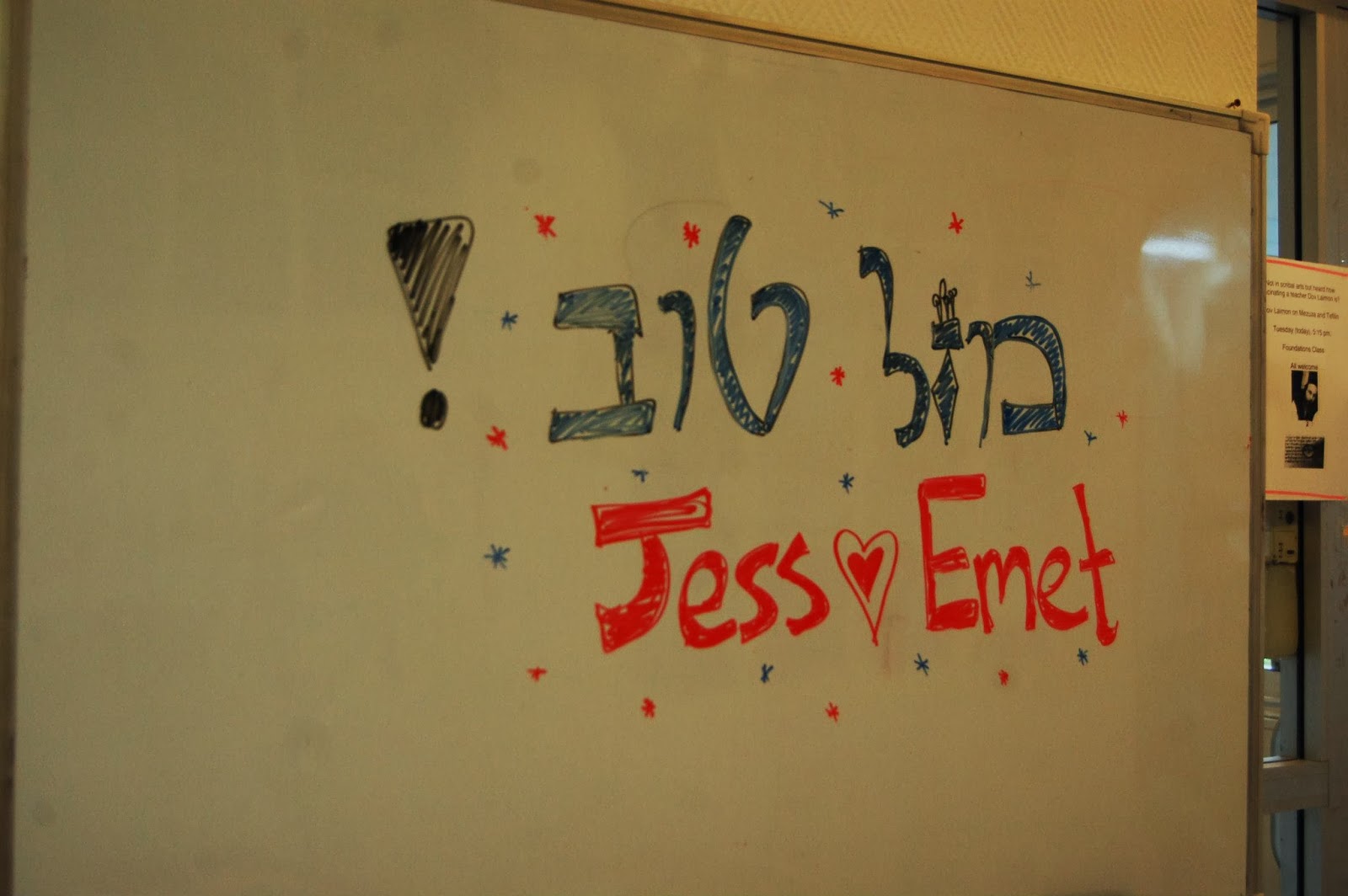
Our wonderful friends at Pardes threw us a New Year's Eve Engagement Party. We are so blessed to have friends and family who are supportive. I was telling our story to one of my classmates, and she explained how emotionally involved she is in our relationship. Many of our classmates feel very connected to us and our story, and more than one person has told me (and Emet) how they admire our relationship and want to establish a relationship as strong as ours. From the beginning, we have been very adamant about being ourselves and our happiness shows. People recognize it, for sure. We have explained our intentionality in our relationship to others, and it resonates with our friends and family.
Here are a few photos of our amazing NYE's engagement party:


Here are a few photos of our amazing NYE's engagement party:


Subscribe to:
Posts (Atom)